
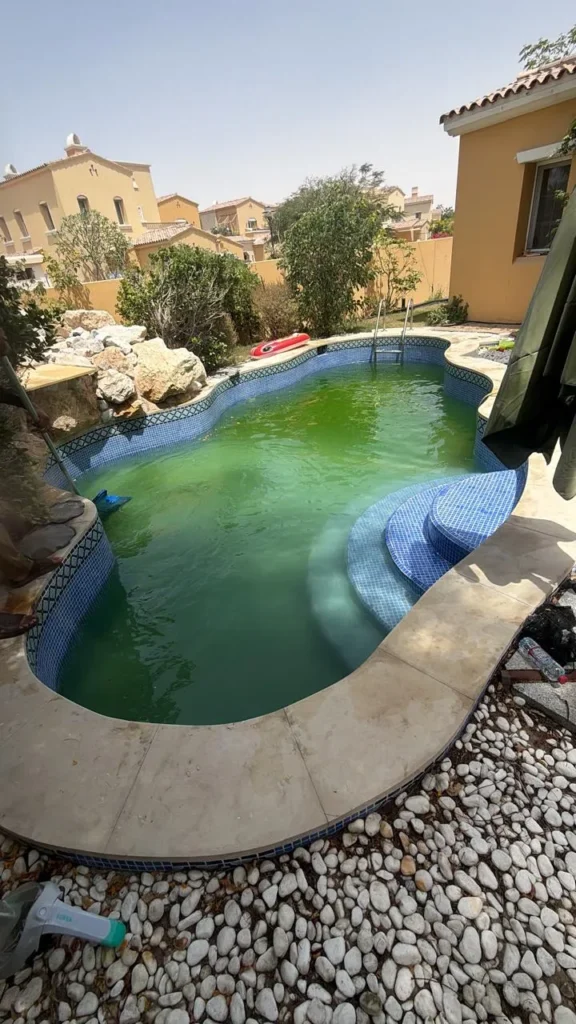
A Dubai pool can look clear on Monday and show a green tint by Thursday without an obvious change in the routine.
As summer temperatures rise, sunlight, pool use, dust and organic debris can increase chlorine demand and put more pressure on filtration and circulation. Algae does not necessarily appear because maintenance stopped. It appears when the conditions become favourable for growth and the routine is no longer keeping up.
This guide explains what causes algae in Dubai pools during summer, what actually prevents it, and what to check when algae keeps coming back.
Dubai Summer Algae Prevention: The Short Version
The most reliable way to prevent pool algae is to keep the entire system working together:
- Keep sanitizer effective for your pool’s CYA level
- Keep pH under control
- Maintain strong water circulation
- Brush walls, steps and corners regularly
- Keep the filter and baskets clean
- Remove dust, leaves and organic debris
- Test water more frequently during periods of heavy use, heat, dust or rain
No single chemical can compensate for poor circulation, neglected surfaces or ineffective filtration.
Why Dubai Summer Makes Algae Harder to Control
Algae spores can be present in pool environments without causing a visible problem. They become an issue when the conditions allow them to grow.
Dubai’s summer can create several of those conditions at once.
Warm Pool Water
Outdoor pools exposed to prolonged sunlight can become considerably warmer during summer.
Warm water can support faster algae growth and increase the demand placed on the pool’s sanitation system. A maintenance routine that worked well during cooler months may need closer monitoring during July and August.
Strong Sunlight and UV Exposure
Ultraviolet light from the sun breaks down free chlorine.
This is particularly important for outdoor pools in Dubai because they receive intense sunlight for long periods. Cyanuric acid, or CYA, helps protect chlorine from UV degradation, but the level needs to remain appropriate for the pool.
The goal is not simply to keep adding chlorine. It is to maintain an effective sanitizer level while keeping the rest of the water chemistry balanced.
Higher Chlorine Demand
Summer can increase chlorine demand through a combination of:
- Higher water temperatures
- Strong sunlight
- Increased pool use
- Sweat and body oils from swimmers
- Dust and organic debris
- Environmental contamination
A dosing schedule designed for cooler conditions may therefore underperform during peak summer.
Dust and Organic Debris
Dubai’s dusty conditions can add another workload to the pool.
Dust, leaves and other organic material can consume sanitizer and increase the load on the filtration system. Organic debris can also introduce nutrients that become more relevant when sanitation and circulation are already inadequate.
Evaporation
High temperatures increase evaporation.
Evaporation does not remove all dissolved substances with the water, so repeated topping-up can gradually change the concentration of minerals and other dissolved materials. Water level changes can also affect equipment operation and circulation if they become significant.
Poor Circulation
Algae often establishes first in places where water movement is weak.
Common areas include:
- Steps
- Corners
- Behind return jets
- Around ladders
- Waterline areas
- Other poorly circulated sections
These areas can become problem spots even when the main body of the pool still looks clear.
What Actually Prevents Algae in a Dubai Pool?
Algae prevention is not about constantly adding more chemicals.
It is about maintaining conditions where algae has little opportunity to establish.
The core elements are:
Effective sanitation: Free chlorine needs to be maintained at a level appropriate to your pool’s CYA concentration.
Controlled pH: Keeping pH within the appropriate operating range helps chlorine remain effective.
Adequate circulation: Moving water reduces stagnant areas where algae can establish.
Regular brushing: Algae can attach to pool surfaces before it becomes obvious in the water.
Efficient filtration: Filtration removes suspended particles and organic material but does not replace sanitation.
Regular debris removal: Leaves, dust and other organic material increase the pool’s chemical and filtration load.
Consistent testing: You cannot reliably correct water chemistry without measuring it.
The Right Chlorine Balance for Dubai Summer
One of the most common summer mistakes is simply adding more chlorine whenever the pool starts looking questionable.
A better approach is to test first.
Free chlorine is the active sanitizer in the pool. The appropriate level depends partly on the pool’s cyanuric acid (CYA) concentration and the type of sanitation system being used.
Cyanuric Acid (CYA)
CYA, also known as pool stabilizer or conditioner, helps protect chlorine from UV degradation in outdoor pools.
Without adequate stabilizer, sunlight can cause free chlorine to fall much faster.
However, too much CYA can also reduce the effectiveness of chlorine. For many residential outdoor pools, a CYA range around 30–50 ppm is commonly used, but the appropriate target should follow the pool system, chemical program and professional guidance.
The important point is balance.
If CYA has accumulated excessively over time, simply adding more chlorine may not solve the problem. Partial water replacement may be necessary to reduce the concentration.
What About pH?
pH also affects chlorine performance.
A practical operating range for many residential pools is around 7.2–7.6, although the correct target can vary depending on the pool and sanitation system.
If pH consistently drifts high, chlorine becomes less effective.
The practical rule is simple:
Test before dosing.
If free chlorine is low, check pH and CYA before automatically adding more chemicals.
Proper pool water treatment starts with testing the water, identifying what is actually out of balance and then making the appropriate correction.
Why does summer increase chlorine demand?
Higher temperatures, stronger sunlight, increased swimming and additional organic debris can all increase the amount of chlorine the pool consumes.
That means summer often requires more frequent monitoring, not simply larger chemical doses.
Pool Shock vs Algaecide: Which Should You Use?
| Situation | Better Approach |
| Preventive routine | Consistent sanitation, pH control and circulation |
| Early algae signs | Correct chemistry + thorough brushing + appropriate shock |
| Established green pool | Algae treatment + shock + sustained filtration |
| Recurring algae | Diagnose the underlying cause |
| After treatment | Restore balanced chemistry before returning to routine |
Pool Shock
Pool shock rapidly increases free chlorine to help kill algae and oxidize organic contaminants.
It can be useful when algae is visible or chlorine has been significantly depleted. However, the treatment works best when the water chemistry is first brought into an appropriate range.
Shocking an unbalanced pool is not a substitute for fixing the underlying problem.
Algaecide
Algaecide can be used as a supplementary treatment for certain algae problems.
It should not replace proper sanitation, pH control, circulation or filtration.
If algae keeps returning because chlorine is not staying effective or circulation is poor, adding algaecide may only provide temporary improvement.
The Practical Decision
If the pool is clear and chemistry is properly maintained, focus on prevention:
Sanitizer + pH + circulation + brushing + filtration
If algae has appeared, correct the water chemistry, physically brush affected surfaces and use an appropriate shock treatment.
If it keeps returning, stop repeatedly treating the symptom and find the cause.
How Pool Circulation Stops Algae Before It Starts
Algae commonly appears first in areas where water movement is weak.
Your circulation system works as a chain:
Pump → Filter → Return Jets → Pool
If one part of that system is underperforming, circulation can suffer.
Check for:
- Blocked pump or skimmer baskets
- Dirty filters
- Weak return flow
- Incorrectly positioned return jets
- Pump performance problems
- Areas where water movement is noticeably poor
Return jets should generally be positioned to encourage broad movement through the pool rather than allowing stagnant pockets to develop.
Run the circulation system for an appropriate amount of time to achieve adequate daily water turnover for your pool and equipment. During Dubai’s summer, closer monitoring may be necessary because of increased heat, sunlight, dust and pool use.
If algae consistently appears in the same corner or around the same steps, investigate circulation before simply increasing chemical doses.
No chemical routine can compensate for consistently poor circulation.
Which Pool Filter Type Controls Algae Best?
No filter type independently prevents algae.
Filtration supports algae control by removing suspended material and maintaining water clarity. Sanitation and circulation remain essential.
Sand Filters
Sand filters are widely used for residential pools.
They are effective for general debris and are relatively straightforward to maintain through backwashing. However, very fine particles can pass through, which is another reason proper sanitation remains important.
Cartridge Filters
Cartridge filters can capture finer particles without requiring backwashing.
They need to be removed and cleaned manually, and high dust loads can increase how often they require attention.
DE Filters
Diatomaceous earth (DE) filters can provide very fine filtration and are capable of capturing smaller particles than many conventional systems.
They can also require more involved maintenance and are less common in some residential pool setups.
The Bottom Line
The best filter is not necessarily the one with the smallest micron rating.
A properly maintained filter that is correctly sized for the pool can perform far better than a neglected high-efficiency filter.
Monitor filter pressure and clean or service the system according to the equipment requirements.
Do Phosphates Cause Algae in Dubai Pools?
Phosphates are a nutrient source for algae.
They can enter pools through dust, organic debris, source water and other environmental sources.
But elevated phosphate levels alone do not automatically create an algae bloom.
If sanitation, pH and circulation are working properly, the presence of phosphates does not mean the pool will necessarily turn green.
Phosphate treatment becomes more relevant when algae repeatedly returns despite the primary factors being properly controlled.
The best approach is to start with the fundamentals:
Sanitation → pH → circulation → filtration → physical cleaning
Only then investigate additional nutrient factors if the problem persists.
Does Rain Cause Algae in Dubai Pools?
Rain itself does not directly create algae.
The problem is what rain can bring with it.
Rain can introduce contaminants, dilute pool water and alter chemical balance. In Dubai, rainfall may also be accompanied by dust and other airborne material.
That contamination can increase chlorine demand and create more work for the filtration system.
After a significant rain or dust event:
- Remove visible debris
- Check and clean skimmer and pump baskets
- Test pH and free chlorine
- Check alkalinity when appropriate
- Correct chemistry based on test results
- Check filter pressure
- Clean or backwash the filter if required
Do not wait until the pool turns green before checking the water.
Your Dubai Summer Pool Maintenance Routine
A consistent routine is one of the simplest ways to prevent algae from gaining a foothold.
Daily
- Check water clarity
- Remove visible debris
- Confirm equipment is operating normally
- Monitor the water level
2–3 Times Per Week
- Test free chlorine
- Test pH
- Look for early algae signs
- Inspect steps, corners and waterline areas
- Check return jets and circulation
- Clean baskets as needed
Weekly
- Brush walls, steps and corners
- Vacuum the pool floor
- Check broader water chemistry
- Check alkalinity, CYA and calcium hardness when appropriate
- Inspect filter pressure
- Review chlorine demand
If the pool is consuming noticeably more chlorine than usual, investigate the reason rather than simply increasing the dose.
After Heavy Use, Dust or Rain
- Retest the water
- Remove debris
- Check baskets
- Check filtration
- Review circulation
- Correct chemistry based on test results
For homeowners who prefer scheduled upkeep, pool maintenance plans can make regular cleaning, testing and chemical checks more consistent throughout the summer.
What to Do When Algae Keeps Coming Back
Recurring algae is one of the most frustrating pool problems.
If the pool turns green again shortly after treatment, repeatedly adding shock is unlikely to be the complete answer.
Work through the possible causes.
1. Is the Sanitizer Actually Staying Effective?
Check free chlorine against the pool’s CYA level.
Also check pH.
If pH has repeatedly been running high, chlorine may not have been performing as effectively as expected.
If CYA has accumulated excessively, the water may require partial replacement rather than simply receiving more chlorine.
2. Is Circulation Adequate?
Inspect:
- Return jets
- Pump basket
- Skimmer
- Filter pressure
- Pump performance
If algae repeatedly appears in exactly the same location, poor circulation should be high on the list of possible causes.
3. Is the Filter Working Correctly?
A filter that has not been properly cleaned can restrict flow and reduce filtration performance.
As part of an algae treatment, the filter should also be checked and cleaned or backwashed as required.
4. Are Pool Surfaces Being Brushed?
Algae can attach to surfaces.
Chemical treatment alone may not remove all of the material from walls, steps and other surfaces.
Physical brushing helps break up attached algae and allows the treatment to work more effectively.
5. Is There Another Environmental Factor?
If sanitation, pH, circulation, filtration and cleaning are all properly controlled, investigate other possible contributors such as:
- High organic contamination
- Dust exposure
- Nutrient load
- Equipment problems
- Persistent circulation issues
Repeatedly shocking the pool without diagnosing the cause treats the symptom rather than the problem.
Keeping a Dubai Pool Clear Without Over-Chlorinating
More chlorine is not always the answer.
Excessive chlorine can cause swimmer discomfort and may contribute to equipment or surface damage, while still failing to solve a circulation or water-balance problem.
Test before dosing.
If chlorine is low and pH is high, correcting the pH may improve chlorine effectiveness.
If CYA has become excessively high, dilution may be more useful than adding additional chlorine.
Treat what the water actually needs — not simply what the pool looks like.
A balanced pool is not achieved by chasing a single number.
Saltwater vs Traditional Chlorine for Algae Prevention
A saltwater pool is still a chlorine pool.
A salt chlorine generator produces chlorine from dissolved salt through electrolysis.
The main difference is how the chlorine is supplied.
A saltwater system can generate chlorine continuously, which can help reduce the gaps associated with manual dosing. But it still requires:
- pH management
- CYA monitoring
- Proper circulation
- Filtration
- Regular testing
- Appropriate chlorine levels
A saltwater pool is therefore not algae-proof.
If sanitation or circulation is neglected, algae can still develop.
UV Sterilisers and Algae Prevention
UV steriliser systems expose water to ultraviolet light as it passes through the treatment unit.
They can supplement a pool’s sanitation system by reducing microorganisms in the water passing through the unit.
However, UV is a supplement rather than a replacement for chlorine.
It only treats water as it passes through the system and does not provide a lasting sanitizer residual throughout the pool.
Chlorine is still required to protect the water from contamination between circulation cycles and from swimmer and environmental loads.
For most residential pools, UV should therefore be viewed as an additional treatment technology rather than a substitute for proper chemical management.
When to Call a Professional Pool Cleaning Service in Dubai
Some algae problems need professional diagnosis rather than another round of chemicals.
Consider professional help when:
- The pool has turned green or cloudy
- Normal treatment is not clearing the water
- Algae keeps returning despite apparently correct readings
- Black or yellow algae has appeared
- Circulation is noticeably weak
- Chemical readings repeatedly drift between visits
- You are unsure whether the problem is chemistry, filtration or circulation
Professional algae removal should address both the immediate water condition and the reason the algae developed.
If your pool needs ongoing care rather than a one-time cleanup, professional pool cleaning can help keep cleaning, water chemistry, circulation and filtration under control throughout Dubai’s demanding summer conditions.
Seeing real results can also help you understand what proper treatment involves. Take a look at these algae removal results from completed pool cleaning work.
Al-Taif Pool Cleaning provides professional algae removal, pool cleaning and summer maintenance across Dubai.
For professional algae removal, summer pool maintenance and water chemistry assessment in Dubai, contact Al-Taif Pool Cleaning.
Frequently Asked Questions
How can I prevent algae in my Dubai pool during summer?
Keep free chlorine at a level appropriate for your CYA, maintain suitable pH, ensure good circulation, brush surfaces regularly, keep the filter clean and test the water more frequently during periods of heavy use, heat, dust or rain. Sanitation, pH and circulation matter more than any supplementary product.
What is the role of cyanuric Acid in preventing algae?
CYA helps protect chlorine from UV degradation in outdoor pools. Too little stabilizer can allow sunlight to reduce chlorine more quickly, while excessive CYA can reduce chlorine effectiveness. The appropriate level depends on the pool and sanitation system.
Is shock treatment better than algaecide for pool algae?
For an established algae problem, shock is commonly part of the corrective treatment, provided the chemistry is appropriate.
Algaecide can be useful as a supplement for certain algae problems, but neither replaces proper sanitation, pH control and circulation.
Can rain cause algae in a Dubai pool?
Rain does not directly cause algae, but it can dilute pool chemistry and introduce contaminants and organic material.
After significant rain or dust, test the water, remove debris and check the filtration system.
Why does my pool algae keep coming back?
Look for the underlying cause.
Common possibilities include ineffective chlorine due to poor water balance, excessive CYA, poor circulation, dirty or restricted filtration, inadequate brushing or high environmental contamination.
Treat the cause, not just the visible algae.
Does a saltwater pool prevent algae better than chlorine?
Saltwater pools generate chlorine through electrolysis.
They can provide more continuous chlorine generation, but they still require proper pH, CYA, filtration, circulation and regular testing.
Neither saltwater nor traditional chlorine systems are immune to algae.
Do phosphates cause pool algae?
Phosphates are a nutrient source for algae, but elevated phosphate levels alone do not necessarily cause an algae bloom.
Investigate phosphate levels when algae keeps returning despite proper sanitation, pH, circulation and filtration.
Can a pool filter remove algae?
A filter can remove suspended algae particles and other contaminants from the water, but it does not prevent algae growth by itself.
Sanitation, circulation and physical cleaning remain essential.
What is the best way to prevent algae in a pool during Dubai summer?
There is no single algae-prevention product that replaces regular maintenance.
The most reliable approach is to maintain effective sanitation, control pH, keep water moving, brush surfaces, maintain the filter and increase monitoring when heat, dust, rain or heavy pool use increases chlorine demand.